




Understanding BIMSTEC: Strategic Significance, Evolution, and Exam-Essential Insights
Vedansh Arora
June 24, 2026
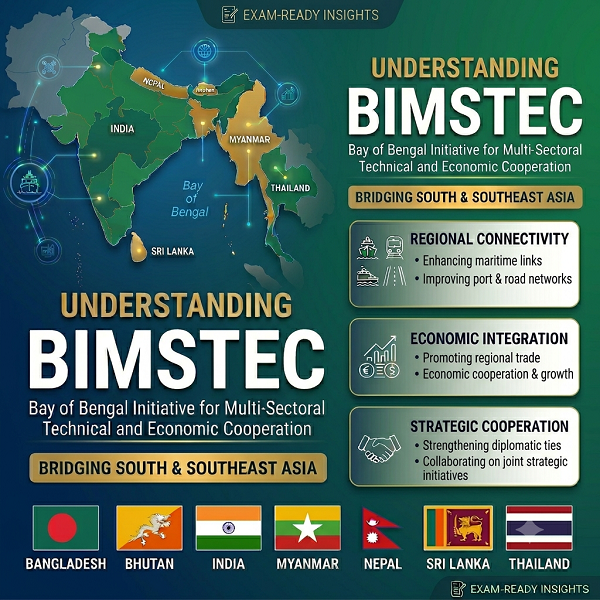
The Bay of Bengal Initiative for Multi-Sectoral Technical and Economic Cooperation (BIMSTEC) serves as a critical regional alignment bridging South and Southeast Asia. As traditional blocks like SAARC face persistent geopolitical gridlocks, BIMSTEC offers a highly functional alternative for economic, technical, and strategic integration.
This comprehensive analysis details the structure, evolution, and strategic priorities of BIMSTEC, optimized for professional and academic reference.
1. Institutional Overview
BIMSTEC was established in 1997 through the signing of the Bangkok Declaration. Headquartered in Dhaka, Bangladesh, it is an inter-regional organization that uniquely links seven nations situated around the geography of the Bay of Bengal.
The organization comprises five member states from South Asia—Bangladesh, Bhutan, India, Nepal, and Sri Lanka—and two from Southeast Asia—Myanmar and Thailand. Together, they bridge the economic and strategic landscapes of these two vital sub-regions.
2. Historical Evolution
The geopolitical footprint of BIMSTEC expanded through distinct phases of geographical and diplomatic evolution:
- June 1997 (BIST-EC): The group was initially formed by four nations—Bangladesh, India, Sri Lanka, and Thailand—under the acronym BIST-EC, standing for Bangladesh, India, Sri Lanka, and Thailand Economic Cooperation.
- December 1997 (BIMST-EC): Myanmar was admitted as a full member, prompting the inclusion of the letter 'M' in the acronym and expanding the bloc's reach toward the ASEAN region.
- 2004 (BIMSTEC): With the admission of Nepal and Bhutan, the organization assumed its current membership. The acronym was re-headlined to its formal institutional title: Bay of Bengal Initiative for Multi-Sectoral Technical and Economic Cooperation.
3. High-Yield Diplomatic Updates
Recent institutional milestones have accelerated the integration of the bloc, driven heavily by outcomes from the 6th BIMSTEC Summit held in Bangkok, Thailand, in April 2025.
- BIMSTEC Bangkok Vision 2030: Member states formally adopted this strategic roadmap to guide the region toward becoming more prosperous, resilient, and open by the end of the decade.
- BIMSTEC Maritime Transport Agreement: This landmark agreement was signed to lower regional shipping costs, standardize maritime protocols, and maximize supply chain efficiency across the Bay of Bengal.
- Digital Financial Integration: India proposed cross-border integration of its Unified Payments Interface (UPI) with member nations to simplify regional trade, ease financial transactions, and boost tourism.
- Institutional Handover: Thailand officially handed over the institutional chairmanship of BIMSTEC to Bangladesh.
- Blue Economy Initiatives: Following the summit, the BIMSTEC Ports Conclave in Visakhapatnam, India (July 2025) convened officials to design advanced frameworks for sustainable maritime resource management.
4. Strategic Significance to India
BIMSTEC acts as a primary anchor for India’s foreign policy, serving three core diplomatic, domestic, and security objectives.
Intersection of Core Foreign Policies
The organization aligns directly with India's Act East Policy, serving as a conduit for connecting with Southeast Asian markets. It simultaneously reinforces the Neighborhood First Policy by prioritizing stable, cooperative relationships with adjacent borders, and advances the SAGAR Policy (Security and Growth for All in the Region) by safeguarding vital Indian Ocean sea lanes.
Domestic Development and Countering China
Domestically, BIMSTEC provides a critical land-and-maritime link between India’s landlocked North-Eastern states and global trade channels via Bangladesh and Myanmar, unlocking significant economic potential. Strategically, it offers a collective mechanism to counter China’s growing maritime assertiveness and submarine presence in the Bay of Bengal, balancing the creeping influence of Beijing's Belt and Road Initiative (BRI).
5. Comparative Structural Analysis: SAARC vs. BIMSTEC
Understanding the fundamental distinctions between SAARC and BIMSTEC highlights why the latter has gained modern diplomatic prominence.
While SAARC is strictly a regional organization focused on South Asia, BIMSTEC is an inter-regional organization linking South and Southeast Asia. SAARC was established during the Cold War era in 1985 and is headquartered in Kathmandu, Nepal. In contrast, BIMSTEC was established in the post-Cold War era in 1997 and is headquartered in Dhaka, Bangladesh.
The membership composition also alters institutional efficacy. SAARC includes eight members, featuring Afghanistan, the Maldives, and Pakistan alongside five current BIMSTEC members. However, the presence of Pakistan and India has historically caused asymmetric power dynamics and bilateral gridlocks that leave SAARC paralyzed. BIMSTEC maintains a more symmetrical balance of power, anchored by two distinct regional leaders—India and Thailand—free from deep-seated bilateral vetoes.
6. Current Challenges and Strategic Way Forward
Underlying Institutional Weaknesses
Despite its potential, BIMSTEC faces structural limitations. Southeast Asian members like Thailand and Myanmar frequently prioritize ASEAN, while India has historically faced criticism for utilizing the bloc primarily as a backup mechanism to bypass SAARC. Furthermore, the foundational Free Trade Agreement (FTA) spanning goods, services, and investments remains unfinalized despite decades of negotiations. Rising internal frictions, such as the Rohingya refugee crisis involving Myanmar and Bangladesh, also threaten cohesive decision-making.
Strategic Way Forward
To maximize its potential, the bloc must transition from institutional visions to concrete delivery. Finalizing a comprehensive, modern FTA is an urgent priority to reduce non-tariff barriers and harmonize regional supply chains. Additionally, India can leverage the Gujral Doctrine—offering unilateral concessions to smaller neighbors without expecting immediate reciprocity—to dispel any concerns about the block becoming an India-dominated entity, thereby building a more cooperative, integrated, and secure Bay of Bengal ecosystem.